07 April 2008
Cool
I can't find my camera right now, which stinks, because I want to show you what it looks like outside right now. The fog... well, there IS fog, but what we really have is a cloud deck at right about 200 feet (that would be OVC002 in pilot-weather-report-speak). And what's cool is there's this building under construction across the way that's right about 200 feet tall right now. It's a pretty cool effect. Probably won't last much longer, but then it's been foggy all morning. I'm going to keep looking for the camera.


04 April 2008
Registry!
People have been asking and clearly the word needs to get out: Smitty and Smittygirl have registered for their wedding!
We are registered at JC Penney, both in stores and on line at jcpenney.com. You can check under either one of our names, but I would suggest using Smittygirl's name since there are a lot of me.
Here is a direct link to the registry. That should work.
Thank you!
We are registered at JC Penney, both in stores and on line at jcpenney.com. You can check under either one of our names, but I would suggest using Smittygirl's name since there are a lot of me.
Here is a direct link to the registry. That should work.
Thank you!
02 April 2008
Smitty's World
You'll notice I haven't been posting much personal stuff lately (I haven't been posting much at all but that's another story). It's not because I have nothing personal to say or anything. What I do plan to say is after the jump.
There's tons going on. We're about 18 days away from the wedding, for starters. There is still much to do, but it's not insurmountable by any means. We have a lot of checks to write, though; I have a lot of checks to write. It's not that I don't have the money. It's that there won't be much money left afterwards, another two months of living expenses after May is it. And we can't live on Smittygirl's salary alone--mainly because of this house.
Hindsight is 20/20. I should have sought basic work--retail or something stupid--back in December or January. I was adamant at first that I wouldn't work unless I made enough to cover the mortgage and condo fees, and that was stupid and shortsighted. Even $100 a week would have been well worth it. I should have seen that at the time as nearly everyone else did, I think.
But I didn't want to work. I have planned for over two years what I was going to do when I got out of the Air Force. I was going to sell this place and move, but before settling someplace new I was going to travel somewhere, for a month or two. Maybe do a long road trip out west. I knew I'd have the savings (that was maybe the second-most-important reason I signed up to go to Djibouti in the first place) and I'd have plenty of move left over from the house sale to live on for a year or two if I wanted.
Well, plans change. Maybe someday we'll go on a roadtrip together, but I'm only too happy to give up those plans to marry the most wonderful woman in the world. It's not even close.
But I still really wanted to take time off when I got out. Trouble is the time I've taken off hasn't really been... okay, it's been worthless. Totally unproductive. I only started working on the book again last week. I haven't done what I needed to to get the condo ready to sell, clean it up, move stuff around. I've just wasted all this time. How pointless. It would have been better to work now and take time off after the move, for example. But again, why be bitter about the past? Can't change it, and the present and future are what matter.
And we are going to move--not because I want to, but because we want to. Both of us individually want to move, and we're ready to move together. But when? How?
How am I going to sell this condo? I lie awake at night worrying that I'm not goin to be able to get rid of this place. The market is such shite, and not to be a lousy salesman but the management company here has this place looking like shite, too. Two shites is a problem. I do think, in my rational moments, that it should sell pretty quick--Smittygirl talked to somebody yesterday who would take it right now, only at a little less than I'd hoped. There may be negotiating room, though. And there's nothing like this condo for sale in downtown for what I'm going to list it for, that's for sure. But rational thought and lying awake in bed at night are not the same thing.
More important, though, is work. Work here? Work where we're going to move? I can't get a job right now. I made a final attempt on Monday this week, called a number from Sunday's classifieds, looking for drivers for a car delivery company. Driving cars from one sales lot to another or from the port to a transshipment point, that sort of stuff. No training needed, start work right away, that sort of thing. But I just can't bring myself to lie to people when I get them on the phone: I can work through the 17th, and then I can work again starting the 30th. And they're not interested in that. It's an hourly job, paid for the days you work, and they still don't care to hire someone for two weeks.
It's not that I blame them. I'm the idiot here, I know that. But it's no use whining about what I should have done three months ago when I can't go back and change it and the present is here now and needs to be dealt with. So I'm looking for work where we plan to move to. As soon as I find it, I'm gone. And we'll be separated for a while, a few weeks, maybe a couple months. Part of the reason I didn't take the pilot job is because I didn't want us to be separated for a few weeks right after the wedding. That's not going to be easy. But it'll have to happen, because I need to take the first job offer that comes my way, whether it's what I want to do or not.
And that concerns me, too. I sort of know what I'd like to do. Actually, scratch that. I know where I'd like to work and why I'd like to work there. I don't know what I'd like to do, but I like to think that I'd be happy to do anything at that particular place. But if I can't get a job there right away, I can't afford to sit around and wait for the right job. I have to just take what's offered. Which means I need to start applying for than I have been. I have mainly been applying at the desired location.
But I don't have to work there anyway, and yesterday I saw a listing elsewhere for a job that seems right up my alley, working for the city of Greenville as a crime analyst. No, not CSI; number crunching, mapmaking, trendspotting, that sort of thing. You know crazy maps I posted last summer that I made? Yeah, nobody paid me for those; I do that in my spare time. So the job really seems like a good fit, and I have basic knowledge of the GIS software they use. But my degree isn't exactly what they want, and my experience is... well, on paper I'm certainly not their ideal candidate. That's been bothering me a lot lately, because, on paper, most of the jobs I see--and this is true anywhere I look, in any city or state--if they like my degree, they want some relevant experience, which I don't have. If they like my experience, they require a degree in something related to it--management or some such. I don't meet their requirements.
Last week I applied for a job at Clemson. It was as a counselor to returning veterans and ex-military, students who need assistance navigating the arcane and treacherous pathways of the VA so they can get their education assistance benefits in a timely manner. I was made for that job. I can navigate a bureaucracy like nobody's business (the key is making an end-run around whatever agency is giving you trouble. Any bureaucracy of reasonable size, and the VA is definitely that, has so many cogs on so many wheels that there are always multiple ways to get anything accomplished), and working for other veterans is very appealing. The job functions were all things I can do and do well, and have experience with, the kind of experience that's actually on my resume. But I don't have any experience in student services. And because of that they didn't even look at my resume.
That was a real bummer. I tried to justify their point of view, but I couldn't care less in reality. Yeah, it's probably better in the long run to cut out a few good applicants than to let a lot of lousy ones through. But that doesn't matter much to me; it's a shame that a job I'd be great at, at the place I want to work, I can't get because of something on paper. It's not me, they never even talked to me. A box wasn't checked, so I didn't get it. Grr.
So that keeps me up at nights, too. Ultimately there are jobs up there I suspect I can get, jobs that don't require anything more than a high school diploma. But I'm having trouble finding an employer that will value my experience without throwing up artificial roadblocks because I don't have the right degree. It's very frustrating.
And that occupies a lot of my time. I submit a resume somewhere for some job at least four days a week. Some of them I really hope I'll hear back from; those are the ones I tell Smittygirl about. The others are ones I doubt I'll ever hear from, because there's something on paper that isn't just what they want.
Who knew the civilian world was just as idiotic as the military?
There's tons going on. We're about 18 days away from the wedding, for starters. There is still much to do, but it's not insurmountable by any means. We have a lot of checks to write, though; I have a lot of checks to write. It's not that I don't have the money. It's that there won't be much money left afterwards, another two months of living expenses after May is it. And we can't live on Smittygirl's salary alone--mainly because of this house.
Hindsight is 20/20. I should have sought basic work--retail or something stupid--back in December or January. I was adamant at first that I wouldn't work unless I made enough to cover the mortgage and condo fees, and that was stupid and shortsighted. Even $100 a week would have been well worth it. I should have seen that at the time as nearly everyone else did, I think.
But I didn't want to work. I have planned for over two years what I was going to do when I got out of the Air Force. I was going to sell this place and move, but before settling someplace new I was going to travel somewhere, for a month or two. Maybe do a long road trip out west. I knew I'd have the savings (that was maybe the second-most-important reason I signed up to go to Djibouti in the first place) and I'd have plenty of move left over from the house sale to live on for a year or two if I wanted.
Well, plans change. Maybe someday we'll go on a roadtrip together, but I'm only too happy to give up those plans to marry the most wonderful woman in the world. It's not even close.
But I still really wanted to take time off when I got out. Trouble is the time I've taken off hasn't really been... okay, it's been worthless. Totally unproductive. I only started working on the book again last week. I haven't done what I needed to to get the condo ready to sell, clean it up, move stuff around. I've just wasted all this time. How pointless. It would have been better to work now and take time off after the move, for example. But again, why be bitter about the past? Can't change it, and the present and future are what matter.
And we are going to move--not because I want to, but because we want to. Both of us individually want to move, and we're ready to move together. But when? How?
How am I going to sell this condo? I lie awake at night worrying that I'm not goin to be able to get rid of this place. The market is such shite, and not to be a lousy salesman but the management company here has this place looking like shite, too. Two shites is a problem. I do think, in my rational moments, that it should sell pretty quick--Smittygirl talked to somebody yesterday who would take it right now, only at a little less than I'd hoped. There may be negotiating room, though. And there's nothing like this condo for sale in downtown for what I'm going to list it for, that's for sure. But rational thought and lying awake in bed at night are not the same thing.
More important, though, is work. Work here? Work where we're going to move? I can't get a job right now. I made a final attempt on Monday this week, called a number from Sunday's classifieds, looking for drivers for a car delivery company. Driving cars from one sales lot to another or from the port to a transshipment point, that sort of stuff. No training needed, start work right away, that sort of thing. But I just can't bring myself to lie to people when I get them on the phone: I can work through the 17th, and then I can work again starting the 30th. And they're not interested in that. It's an hourly job, paid for the days you work, and they still don't care to hire someone for two weeks.
It's not that I blame them. I'm the idiot here, I know that. But it's no use whining about what I should have done three months ago when I can't go back and change it and the present is here now and needs to be dealt with. So I'm looking for work where we plan to move to. As soon as I find it, I'm gone. And we'll be separated for a while, a few weeks, maybe a couple months. Part of the reason I didn't take the pilot job is because I didn't want us to be separated for a few weeks right after the wedding. That's not going to be easy. But it'll have to happen, because I need to take the first job offer that comes my way, whether it's what I want to do or not.
And that concerns me, too. I sort of know what I'd like to do. Actually, scratch that. I know where I'd like to work and why I'd like to work there. I don't know what I'd like to do, but I like to think that I'd be happy to do anything at that particular place. But if I can't get a job there right away, I can't afford to sit around and wait for the right job. I have to just take what's offered. Which means I need to start applying for than I have been. I have mainly been applying at the desired location.
But I don't have to work there anyway, and yesterday I saw a listing elsewhere for a job that seems right up my alley, working for the city of Greenville as a crime analyst. No, not CSI; number crunching, mapmaking, trendspotting, that sort of thing. You know crazy maps I posted last summer that I made? Yeah, nobody paid me for those; I do that in my spare time. So the job really seems like a good fit, and I have basic knowledge of the GIS software they use. But my degree isn't exactly what they want, and my experience is... well, on paper I'm certainly not their ideal candidate. That's been bothering me a lot lately, because, on paper, most of the jobs I see--and this is true anywhere I look, in any city or state--if they like my degree, they want some relevant experience, which I don't have. If they like my experience, they require a degree in something related to it--management or some such. I don't meet their requirements.
Last week I applied for a job at Clemson. It was as a counselor to returning veterans and ex-military, students who need assistance navigating the arcane and treacherous pathways of the VA so they can get their education assistance benefits in a timely manner. I was made for that job. I can navigate a bureaucracy like nobody's business (the key is making an end-run around whatever agency is giving you trouble. Any bureaucracy of reasonable size, and the VA is definitely that, has so many cogs on so many wheels that there are always multiple ways to get anything accomplished), and working for other veterans is very appealing. The job functions were all things I can do and do well, and have experience with, the kind of experience that's actually on my resume. But I don't have any experience in student services. And because of that they didn't even look at my resume.
That was a real bummer. I tried to justify their point of view, but I couldn't care less in reality. Yeah, it's probably better in the long run to cut out a few good applicants than to let a lot of lousy ones through. But that doesn't matter much to me; it's a shame that a job I'd be great at, at the place I want to work, I can't get because of something on paper. It's not me, they never even talked to me. A box wasn't checked, so I didn't get it. Grr.
So that keeps me up at nights, too. Ultimately there are jobs up there I suspect I can get, jobs that don't require anything more than a high school diploma. But I'm having trouble finding an employer that will value my experience without throwing up artificial roadblocks because I don't have the right degree. It's very frustrating.
And that occupies a lot of my time. I submit a resume somewhere for some job at least four days a week. Some of them I really hope I'll hear back from; those are the ones I tell Smittygirl about. The others are ones I doubt I'll ever hear from, because there's something on paper that isn't just what they want.
Who knew the civilian world was just as idiotic as the military?
Where are the thieves?
Oh my God. Apparently, Robert Mugabe did NOT steal last Saturday's election in Zimbabwe. Even his own handlers seem to admit as much and the old man is said to be looking for a way out that somehow saves face. Not only that, his Zanu-PF party appears to have lost the majority in parliament.
Granted, even a man as blind and venal as Robert Mugabe had to know he has completely destroyed that country--a once-prosperous beacon of hope in Africa--and he has no authority to repair it. It's hard to believe he didn't steal the election, though, as he's done it before and that's pretty standard for African democracies lately; witness Kenya. I'm just dumbfounded. And waiting for the other shoe to drop; perhaps later today or tomorrow the election commission will report that Mugabe won after all.
I would have to argue that Mugabe, who may at one time have just been prickly, has crossed over into the realm of evil. But even evil people may be perceptive enough to know when to cut bait, and if I was Mugabe I'd be running for cover. In no way do I envy Morgan Tsvangirai, the opposition leader who seems to have won the presidency. He has one of the toughest jobs in Africa ahead of him, and that's saying something. How do you fix 100,000% inflation? I mean, really, how? Can you even conceive of that? The last place to suffer from inflation that high--and I mean, we've seen 1000% inflation in Zimbabwe for two years and Indonesia and other countries have seen bouts of it, but this is 100 times that--was Weimar Germany, and we all know how that turned out. It's cheaper to burn the Zimbabwean dollar for heat than it is to use it as currency.
And even if he gets the inflation under control, he has to deal with an utterly broken and destroyed economy. Once prosperous farms that employed thousands of workers have been broken up and given to Mugabe's cronies, and now sit fallow. The former workers have been reduced to subsistence farming on tiny plots of land, and no one who isn't part of Mugabe's personal clique has the money to reassemble a commercially viable farm. Unfortunately those are the last people you want buying up land.
Tsvangirai himself has been left to hang by the political leadership of the surrounding countries, ever since he was beaten to within an inch of his life and has skull smashed by Mugabe's police during a political rally a year ago. Mugabe was such a hero of the revolution that other leaders were loath to say anything against him; with him out of the picture how easy will it be for Tsvangirai to regain the confidence and support of his neighbors? He needs it, without question.
There's also the potential for violence. Fortunately, both Mugabe and Tsvangirai headed parties whose basis was in something other than ethnic identity. But Tsvangirai draws most of his support from urban areas, whereas Mugabe's support was strongest in the countryside. This is a split that could cause serious problems down the road if things don't start to improve soon. If life gets much worse for the countryside (it's already as bad as anywhere else in the world) might they rise against Tsvangirai's supporters? If things fail to improve quickly enough in the cities might Tsvangirai's supporters attack Zanu-PF members who appear well-off? And what is going to become of Mugabe's police force, one of the most brutal on the continent? They probably won't just waltz off into the sunset.
The list of problems is so long perhaps Mugabe just decided it was time to leave. By not stealing the election he at least gets credit for being a good democrat. It's never too early to start working on your legacy.
Granted, even a man as blind and venal as Robert Mugabe had to know he has completely destroyed that country--a once-prosperous beacon of hope in Africa--and he has no authority to repair it. It's hard to believe he didn't steal the election, though, as he's done it before and that's pretty standard for African democracies lately; witness Kenya. I'm just dumbfounded. And waiting for the other shoe to drop; perhaps later today or tomorrow the election commission will report that Mugabe won after all.
I would have to argue that Mugabe, who may at one time have just been prickly, has crossed over into the realm of evil. But even evil people may be perceptive enough to know when to cut bait, and if I was Mugabe I'd be running for cover. In no way do I envy Morgan Tsvangirai, the opposition leader who seems to have won the presidency. He has one of the toughest jobs in Africa ahead of him, and that's saying something. How do you fix 100,000% inflation? I mean, really, how? Can you even conceive of that? The last place to suffer from inflation that high--and I mean, we've seen 1000% inflation in Zimbabwe for two years and Indonesia and other countries have seen bouts of it, but this is 100 times that--was Weimar Germany, and we all know how that turned out. It's cheaper to burn the Zimbabwean dollar for heat than it is to use it as currency.
And even if he gets the inflation under control, he has to deal with an utterly broken and destroyed economy. Once prosperous farms that employed thousands of workers have been broken up and given to Mugabe's cronies, and now sit fallow. The former workers have been reduced to subsistence farming on tiny plots of land, and no one who isn't part of Mugabe's personal clique has the money to reassemble a commercially viable farm. Unfortunately those are the last people you want buying up land.
Tsvangirai himself has been left to hang by the political leadership of the surrounding countries, ever since he was beaten to within an inch of his life and has skull smashed by Mugabe's police during a political rally a year ago. Mugabe was such a hero of the revolution that other leaders were loath to say anything against him; with him out of the picture how easy will it be for Tsvangirai to regain the confidence and support of his neighbors? He needs it, without question.
There's also the potential for violence. Fortunately, both Mugabe and Tsvangirai headed parties whose basis was in something other than ethnic identity. But Tsvangirai draws most of his support from urban areas, whereas Mugabe's support was strongest in the countryside. This is a split that could cause serious problems down the road if things don't start to improve soon. If life gets much worse for the countryside (it's already as bad as anywhere else in the world) might they rise against Tsvangirai's supporters? If things fail to improve quickly enough in the cities might Tsvangirai's supporters attack Zanu-PF members who appear well-off? And what is going to become of Mugabe's police force, one of the most brutal on the continent? They probably won't just waltz off into the sunset.
The list of problems is so long perhaps Mugabe just decided it was time to leave. By not stealing the election he at least gets credit for being a good democrat. It's never too early to start working on your legacy.
25 March 2008
What's going on out there?
Hits on this blog have taken a notable upturn over the last two months. Where before I was getting about 20-25 a day on average, most of them no doubt from a handful of loyal readers, over the last six weeks we've averaged more like 50 a day. This is wonderful, of course, and I welcome whoever stops by, but who the heck are you people and where are you coming from?
Actually, I can find that out, thanks to Site Meter.
For example, among the last 100 visitors was one from Trinidad and Tobago, who stopped by to read the review of The Moon is a Harsh Mistress. And there was a visitor from Singapore, who got caught up in the whole Conocarpus lancifolius saga from some years back. That series of posts, actually, has produced a lot of traffic from around the Indian Ocean basin. This blog actually collects just about every scrap of information about those trees that appears on the internet anywhere, so that's not hard to understand. Someone way up in the frozen north of Churchill, Manitoba, Canada, dropped in to read Part I of my What is the U.S. Doing in Djibouti series. Which I never did finish.
Actually, apart from Conocarpus lancifolius, the three things that seem to bring most serchers to this blog are, in order, pottery pictures (pity I can't make any more for a while), Willa Cather's O Pioneers (no doubt high school students looking for a way out of reading it), and a picture of a King Air I posted about four years ago. Lots of people look for that King Air. I don't even remember why I posted it.
One recent visitor, however, ran a Google search for, "aaaaaaaaaaaaaaaaaaaaaa" and found a post I'd written under that title. I have no idea what they were really looking for, but I hope they found it eventually.
Ah well. I didn't have much to say today. I applied for three jobs today, in two different cities. It would be nice to get at least one of them (particularly the one up yonder in that other state). Oh, and I started rewriting Lauderdale over the weekend, too. Got almost 2000 words in yesterday. If I keep up a 2000-word-per-day pace, I'll have it finished by... hmm, including time off for the honeymoon... Gee, May 24th. That's not so bad. I think I'll set "End of June" as my goal, though.
Actually, I can find that out, thanks to Site Meter.
For example, among the last 100 visitors was one from Trinidad and Tobago, who stopped by to read the review of The Moon is a Harsh Mistress. And there was a visitor from Singapore, who got caught up in the whole Conocarpus lancifolius saga from some years back. That series of posts, actually, has produced a lot of traffic from around the Indian Ocean basin. This blog actually collects just about every scrap of information about those trees that appears on the internet anywhere, so that's not hard to understand. Someone way up in the frozen north of Churchill, Manitoba, Canada, dropped in to read Part I of my What is the U.S. Doing in Djibouti series. Which I never did finish.
Actually, apart from Conocarpus lancifolius, the three things that seem to bring most serchers to this blog are, in order, pottery pictures (pity I can't make any more for a while), Willa Cather's O Pioneers (no doubt high school students looking for a way out of reading it), and a picture of a King Air I posted about four years ago. Lots of people look for that King Air. I don't even remember why I posted it.
One recent visitor, however, ran a Google search for, "aaaaaaaaaaaaaaaaaaaaaa" and found a post I'd written under that title. I have no idea what they were really looking for, but I hope they found it eventually.
Ah well. I didn't have much to say today. I applied for three jobs today, in two different cities. It would be nice to get at least one of them (particularly the one up yonder in that other state). Oh, and I started rewriting Lauderdale over the weekend, too. Got almost 2000 words in yesterday. If I keep up a 2000-word-per-day pace, I'll have it finished by... hmm, including time off for the honeymoon... Gee, May 24th. That's not so bad. I think I'll set "End of June" as my goal, though.
22 March 2008
Little Green Men
If it weren't for a gift inscription on the inside page (thank you, M & L!), I would have no idea how long I've had Christopher Buckley's Little Green Men sitting unread on my bookshelves.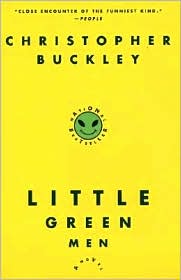 But thanks to the inscription I know it's been six years and change. The first few chapters seemed familiar and I think I picked it up at some point and abandoned it, I don't know why. Unlike the previous, this is not a book worth abandoning unread.
Little Green Men is funny and knowing and wise in that snarky post-Lewinsky Washington way Chris Buckley has. I like his work, and this is representative. I don't have a lot to say about it other than that it's a bit deeper than such things tend to be and the story is a rollicking good ride. I finished it in less than a week if that's saying anything, and I haven't exactly been reading at a quick pace this year.
The book is essentially three Frankenstein stories interlaid, each monster created by the monster before it, each more out of control than the one before it. Makes for a good ride. There are comments I'd like to make about some of the author's choices and some of the points in the story, but I don't think I can without giving the thing away, and I don't want to do that. So, suffice to say, a nice quick read, good book, well-written, most enjoyable.
But thanks to the inscription I know it's been six years and change. The first few chapters seemed familiar and I think I picked it up at some point and abandoned it, I don't know why. Unlike the previous, this is not a book worth abandoning unread.Little Green Men is funny and knowing and wise in that snarky post-Lewinsky Washington way Chris Buckley has. I like his work, and this is representative. I don't have a lot to say about it other than that it's a bit deeper than such things tend to be and the story is a rollicking good ride. I finished it in less than a week if that's saying anything, and I haven't exactly been reading at a quick pace this year.
The book is essentially three Frankenstein stories interlaid, each monster created by the monster before it, each more out of control than the one before it. Makes for a good ride. There are comments I'd like to make about some of the author's choices and some of the points in the story, but I don't think I can without giving the thing away, and I don't want to do that. So, suffice to say, a nice quick read, good book, well-written, most enjoyable.
Little Green Men
If it weren't for a gift inscription on the inside page (thank you, M & L!), I would have no idea how long I've had Christopher Buckley's Little Green Men sitting unread on my bookshelves.But thanks to the inscription I know it's been six years and change. The first few chapters seemed familiar and I think I picked it up at some point and abandoned it, I don't know why. Unlike the previous, this is not a book worth abandoning unread.
Little Green Men is funny and knowing and wise in that snarky post-Lewinsky Washington way Chris Buckley has. I like his work, and this is representative. I don't have a lot to say about it other than that it's a bit deeper than such things tend to be and the story is a rollicking good ride. I finished it in less than a week if that's saying anything, and I haven't exactly been reading at a quick pace this year.
The book is essentially three Frankenstein stories interlaid, each monster created by the monster before it, each more out of control than the one before it. Makes for a good ride. There are comments I'd like to make about some of the author's choices and some of the points in the story, but I don't think I can without giving the thing away, and I don't want to do that. So, suffice to say, a nice quick read, good book, well-written, most enjoyable.
But thanks to the inscription I know it's been six years and change. The first few chapters seemed familiar and I think I picked it up at some point and abandoned it, I don't know why. Unlike the previous, this is not a book worth abandoning unread.Little Green Men is funny and knowing and wise in that snarky post-Lewinsky Washington way Chris Buckley has. I like his work, and this is representative. I don't have a lot to say about it other than that it's a bit deeper than such things tend to be and the story is a rollicking good ride. I finished it in less than a week if that's saying anything, and I haven't exactly been reading at a quick pace this year.
The book is essentially three Frankenstein stories interlaid, each monster created by the monster before it, each more out of control than the one before it. Makes for a good ride. There are comments I'd like to make about some of the author's choices and some of the points in the story, but I don't think I can without giving the thing away, and I don't want to do that. So, suffice to say, a nice quick read, good book, well-written, most enjoyable.
18 March 2008
The Pyrotechnic Insanitarium
 Pyrotechnic Insanitarium was the term used by a contemporary writer to describe Coney Island in its heyday at the turn of the 20th Century. I think I would quite enjoy a book about Coney Island's history. Pity this wasn't it.
Mark Dery wrote The Pyrotechnic Insanitarium: American Culture on the Brink way back in 1999. It shows. It's been a very long nine years. And this is a pretty long review so I'll put it after the jump.
Leaving aside the problem that an unemployed person probably shouldn't read a book like this anyway--it's fairly depressing--I didn't bother finishing it for other reasons. From page one you know you're going to be reading things that may not apply any more. The before/after of 9/11 is a pretty severe contrast, and attempts to deconstruct American culture on the eve of the new millenium--and there were many--couldn't have predicted 9/11 or the turn said culture would take. Couldn't have predicted George Bush, either, who, like it or not, has defined this decade in ways historians will still be discussing a hundred years from now. And anyway, as Dery helpfully points out, the turn of the year 2000 had no special meaning whatsoever apart from what had been imbued to it by the culture: 2000 was itself a cultural creation, and had it merely been the turn from 1994 to 1995 all the cultural oddities and excesses Dery writes about would have been... well, they still would have been around. End-of-the-millenium angst was all well and good (Y2K anyone?) but most of the cultural issues Dery deals with were in the air already and only the notion that "surely, something big is going to happen" made any of it seem like it was a sign of the end times.
The fact is the 20th Century may have lasted from about 1918 until 1990, by some estimates, or it may have run until 2001. Perhaps the years from the fall of the Soviet Union to the attack on the World Trade Center were simply an interlude, history and humanity deciding whether we were going to go back and relive the violence and decadence of the 20th Century again or find something else to do. (Unfortunately I think we've decided to relive the 20th.) In any event, the constant reference to "fin-de-millenium" (Dery's terminology) makes the book feel older than it should--especially considering that, just as the cultural issues Dery discusses were extant before the 1998-1999 oh-my-god-here-comes-the-millenium era, they are still out there today.
Unfortunately the issues Dery chooses to discuss are not altogether nice. There are chapters about artists who use sheep entrails to make... not much, really, and about a photographic study of an exibition of Peter the Great's collection of freaks and mutants in formaldehyde. Things that are, in essence, gross, and I for one don't feel like reading about gross for the sake of gross. So, it's gross. So, there are gross things in life. It's one thing for an artist to make a statement that ignoring gross things or pretending they don't exist is immature, that's valid cultural criticism. It's something else to force gross down my throat because you think I'm immature. Fuck you.
Ultimately though it's not the nature of subject matter that drags the book down, since some people find such topics highly entertaining, if not arousing (I think I know some people like that. Not that I know them well, nor do I want to). There are other problems.
Dery's focus is relentlessly negative. Now, I didn't finish the book. I didn't even get halfway through, and I wasn't finished with the second section (out of 16) before I was skimming. It's possible that, in the later sections--well, in the 16th section anyway--Dery turns it all around and instead of just piling criticism atop depression ad infinitum he find something redeeming, some reassurance about the future of our society. But the fact that he labelled the conclusion "Last Things" and not "Last Words" leads me to believe the final rapier thrust in this one-sided fencing match is just like all the rest: straight to the undefended heart.
Let's be honest for a moment, shall we? Skewering American culture and society is easy. I do it. You do it. We all do it. The society we live in is the most individualistic on Earth, in history, and the fact that there is so much low-brow, so much stupidity, so many mass movements in one direction or another, so much low-grade shouting being passed off as debate, is a consequence of that. As an occasionally self-proclaimed libertarian I must accept that. But as much as I adore liberty, it results in a culture that is dominated by the lowest elements--and too much liberty scares people and makes them follow the crowd. Picking on our society does not require a 270 page book, and frankly the book just doesn't stay interesting. I may not have known about Renee French's Kinderculture series of skin-crawlingly creepy childhood cartoons, but I'm hardly surprised to find that they exist and, frankly, my life is not any richer for the knowledge. I don't need proof that most people are sickos. I suspect it anyway.
I read through to the fourth section, which was about the psycho-killer clown phenomenon. This interests me a great deal, as I have long found clowns to be mildly creepy. Not scary, but a little... je ne sais quoi. I do not like clowns for the most part, though I recognize that clowning has a long history and that our conception of them as scary pedophiles is a fairly recent invention. Clown antics, clowning around, those things are great. It's the dress-up part of clowns that is disturbing, more than anything, the idea of subjugating your whole self to another persona, a persona you yourself have created, one with no "character" or backstory per se but which relies entirely on the physical concealment of the self. A clown is a clown is a clown, after all. There's nothing creepy about acting, but clowning is not acting. Clowning is the elimination of the self: literally, in self, as it requires concealing the self solely for the purpose of being made ridiculous in the eyes of others. I just don't get it.
The chapter on scary clowns is... well, a little scarier than I want clowns to be. Dery draws heavily on the story of John Wayne Gacy, the serial killer who dressed up like a clown to lure young men into his home so he could kill them. Nice, right? But Gacy's murders took place in the 1970s and while certainly Gacy is guilty of creating a lot of the suspicion of clowns, I think Dery spends too much time talking about him. As it is, though, Dery makes a good point in his discussion that our mass distrust of clowns and people who would dress up like clowns has morphed over time into a general distrust of almost anyone who makes a living working with children. I suppose it's only a matter of time before parents start distrusting teachers simply because teachers want to work with children. Perhaps this is how the society in Children of Men came to be.
And the good point Dery makes is a problem, too. He makes some good points. He talks about the dumbing-down of culture and to what degree it is a real phenomenon (yes and no; there have always been plenty of people to partake in low-brow culture and there have always been performers willing to make jokes about shit, farts, and dicks. The difference is now it's much more widespread because broadcast media finds it more profitable to appeal to the lowest common denominator--after all, even the most hoity-toity highbrow cultural critic will find a few chuckles in Ace Ventura: Pet Detective, but try getting your average joe with the emotional maturity of an 8th grader excited about Verdi's Aida, for example. He talks about how Edvard Munch's The Scream was taken in its day and how the image has been appropriated here a century later. Very interesting stuff.
Unfortunately, Dery's writing gets tiresome very quickly. He references every obscure philosopher and writer he can think of, and though he provides copious endnotes so we can read more about these depressing topics ourselves if we should for some reason want to, frankly he attempts to marry low-brow topics with high-brow writing and it just comes off weird. And annoying. It's as if Dery knows he's taking aim at such a large target that there's no reason anyone should take him seriously (a competent 8-year-old could critique American society), so he inflates his writing in the worst academic style so he can be taken seriously.
In short, even if it was late 1999 and I was specifically looking for a book about current cultural phenomena of a depressing and/or disgusting nature, I probably wouldn't have been too excited by this one.
The Pyrotechnic Insanitarium
Pyrotechnic Insanitarium was the term used by a contemporary writer to describe Coney Island in its heyday at the turn of the 20th Century. I think I would quite enjoy a book about Coney Island's history. Pity this wasn't it.Mark Dery wrote The Pyrotechnic Insanitarium: American Culture on the Brink way back in 1999. It shows. It's been a very long nine years. And this is a pretty long review so I'll put it after the jump.
Leaving aside the problem that an unemployed person probably shouldn't read a book like this anyway--it's fairly depressing--I didn't bother finishing it for other reasons. From page one you know you're going to be reading things that may not apply any more. The before/after of 9/11 is a pretty severe contrast, and attempts to deconstruct American culture on the eve of the new millenium--and there were many--couldn't have predicted 9/11 or the turn said culture would take. Couldn't have predicted George Bush, either, who, like it or not, has defined this decade in ways historians will still be discussing a hundred years from now. And anyway, as Dery helpfully points out, the turn of the year 2000 had no special meaning whatsoever apart from what had been imbued to it by the culture: 2000 was itself a cultural creation, and had it merely been the turn from 1994 to 1995 all the cultural oddities and excesses Dery writes about would have been... well, they still would have been around. End-of-the-millenium angst was all well and good (Y2K anyone?) but most of the cultural issues Dery deals with were in the air already and only the notion that "surely, something big is going to happen" made any of it seem like it was a sign of the end times.
The fact is the 20th Century may have lasted from about 1918 until 1990, by some estimates, or it may have run until 2001. Perhaps the years from the fall of the Soviet Union to the attack on the World Trade Center were simply an interlude, history and humanity deciding whether we were going to go back and relive the violence and decadence of the 20th Century again or find something else to do. (Unfortunately I think we've decided to relive the 20th.) In any event, the constant reference to "fin-de-millenium" (Dery's terminology) makes the book feel older than it should--especially considering that, just as the cultural issues Dery discusses were extant before the 1998-1999 oh-my-god-here-comes-the-millenium era, they are still out there today.
Unfortunately the issues Dery chooses to discuss are not altogether nice. There are chapters about artists who use sheep entrails to make... not much, really, and about a photographic study of an exibition of Peter the Great's collection of freaks and mutants in formaldehyde. Things that are, in essence, gross, and I for one don't feel like reading about gross for the sake of gross. So, it's gross. So, there are gross things in life. It's one thing for an artist to make a statement that ignoring gross things or pretending they don't exist is immature, that's valid cultural criticism. It's something else to force gross down my throat because you think I'm immature. Fuck you.
Ultimately though it's not the nature of subject matter that drags the book down, since some people find such topics highly entertaining, if not arousing (I think I know some people like that. Not that I know them well, nor do I want to). There are other problems.
Dery's focus is relentlessly negative. Now, I didn't finish the book. I didn't even get halfway through, and I wasn't finished with the second section (out of 16) before I was skimming. It's possible that, in the later sections--well, in the 16th section anyway--Dery turns it all around and instead of just piling criticism atop depression ad infinitum he find something redeeming, some reassurance about the future of our society. But the fact that he labelled the conclusion "Last Things" and not "Last Words" leads me to believe the final rapier thrust in this one-sided fencing match is just like all the rest: straight to the undefended heart.
Let's be honest for a moment, shall we? Skewering American culture and society is easy. I do it. You do it. We all do it. The society we live in is the most individualistic on Earth, in history, and the fact that there is so much low-brow, so much stupidity, so many mass movements in one direction or another, so much low-grade shouting being passed off as debate, is a consequence of that. As an occasionally self-proclaimed libertarian I must accept that. But as much as I adore liberty, it results in a culture that is dominated by the lowest elements--and too much liberty scares people and makes them follow the crowd. Picking on our society does not require a 270 page book, and frankly the book just doesn't stay interesting. I may not have known about Renee French's Kinderculture series of skin-crawlingly creepy childhood cartoons, but I'm hardly surprised to find that they exist and, frankly, my life is not any richer for the knowledge. I don't need proof that most people are sickos. I suspect it anyway.
I read through to the fourth section, which was about the psycho-killer clown phenomenon. This interests me a great deal, as I have long found clowns to be mildly creepy. Not scary, but a little... je ne sais quoi. I do not like clowns for the most part, though I recognize that clowning has a long history and that our conception of them as scary pedophiles is a fairly recent invention. Clown antics, clowning around, those things are great. It's the dress-up part of clowns that is disturbing, more than anything, the idea of subjugating your whole self to another persona, a persona you yourself have created, one with no "character" or backstory per se but which relies entirely on the physical concealment of the self. A clown is a clown is a clown, after all. There's nothing creepy about acting, but clowning is not acting. Clowning is the elimination of the self: literally, in self, as it requires concealing the self solely for the purpose of being made ridiculous in the eyes of others. I just don't get it.
The chapter on scary clowns is... well, a little scarier than I want clowns to be. Dery draws heavily on the story of John Wayne Gacy, the serial killer who dressed up like a clown to lure young men into his home so he could kill them. Nice, right? But Gacy's murders took place in the 1970s and while certainly Gacy is guilty of creating a lot of the suspicion of clowns, I think Dery spends too much time talking about him. As it is, though, Dery makes a good point in his discussion that our mass distrust of clowns and people who would dress up like clowns has morphed over time into a general distrust of almost anyone who makes a living working with children. I suppose it's only a matter of time before parents start distrusting teachers simply because teachers want to work with children. Perhaps this is how the society in Children of Men came to be.
And the good point Dery makes is a problem, too. He makes some good points. He talks about the dumbing-down of culture and to what degree it is a real phenomenon (yes and no; there have always been plenty of people to partake in low-brow culture and there have always been performers willing to make jokes about shit, farts, and dicks. The difference is now it's much more widespread because broadcast media finds it more profitable to appeal to the lowest common denominator--after all, even the most hoity-toity highbrow cultural critic will find a few chuckles in Ace Ventura: Pet Detective, but try getting your average joe with the emotional maturity of an 8th grader excited about Verdi's Aida, for example. He talks about how Edvard Munch's The Scream was taken in its day and how the image has been appropriated here a century later. Very interesting stuff.
Unfortunately, Dery's writing gets tiresome very quickly. He references every obscure philosopher and writer he can think of, and though he provides copious endnotes so we can read more about these depressing topics ourselves if we should for some reason want to, frankly he attempts to marry low-brow topics with high-brow writing and it just comes off weird. And annoying. It's as if Dery knows he's taking aim at such a large target that there's no reason anyone should take him seriously (a competent 8-year-old could critique American society), so he inflates his writing in the worst academic style so he can be taken seriously.
In short, even if it was late 1999 and I was specifically looking for a book about current cultural phenomena of a depressing and/or disgusting nature, I probably wouldn't have been too excited by this one.
Subscribe to:
Posts (Atom)