They say in prison a man'll do most anything to keep his mind occupied... (ten points if you know the quote)
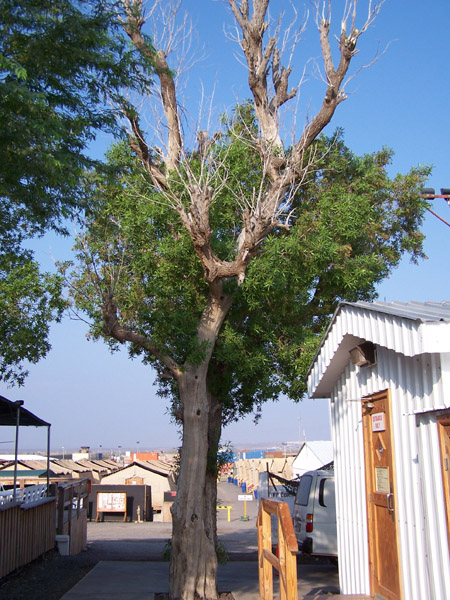
The same is true on deployments. Since this is the first location I've ever been to that had actual trees, I thought I'd try to determine what kind of trees we had on this base.
Acacia nilotica was easy. The others... not so much.
I started by going through the list of trees at the
Djibouti Flora website. I’d copy down the latin name of the tree and paste it into a Google image search. Frequently if I didn’t find any pictures with the genus and species names, I’d try a search with just the genus name.
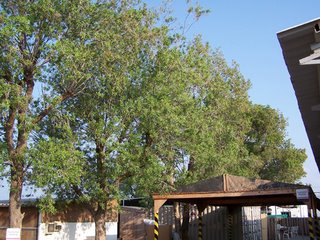
In so doing I searched for the genus
Conocarpus, meaning to look for
Conocarpus lancifolius.
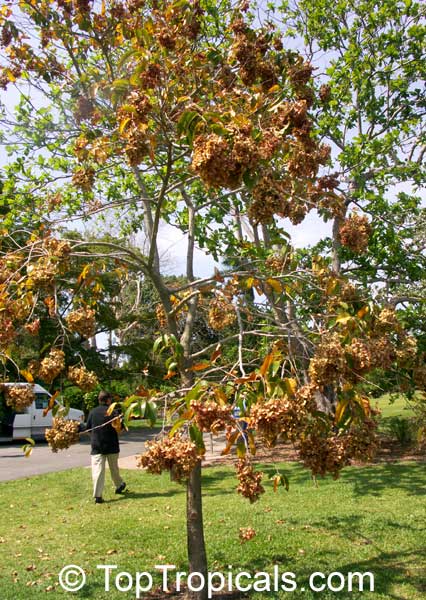
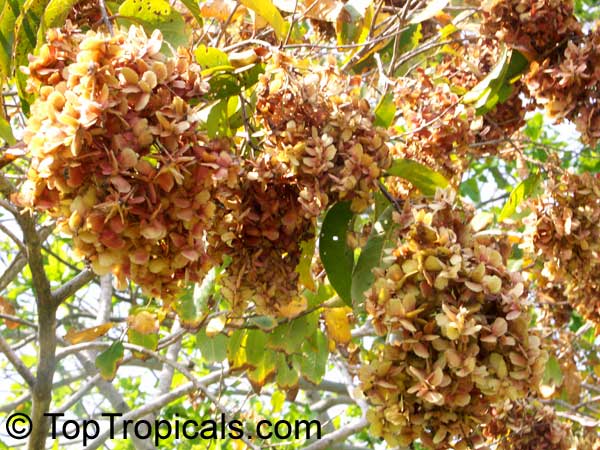
Conocarpus is the genus name for the Buttonwood tree (sometimes called Button Mangrove although it is not a mangrove), a common tree in South Florida and the Everglades to there and to the Caribbean and parts of South America and west Africa. The buttonwood is notable for, among other things, the fruit it produces, which is a small cone-like structure (hence the genus name) containing dozens of tiny seeds and borne in clusters on the branch. This is an
excellent picture of buttonwood leaves and fruit. The picture posted here is one I took of
Conocarpus lancifolius for comparison, as are all other pictures posted here (linked pictures are of other trees).
The search for
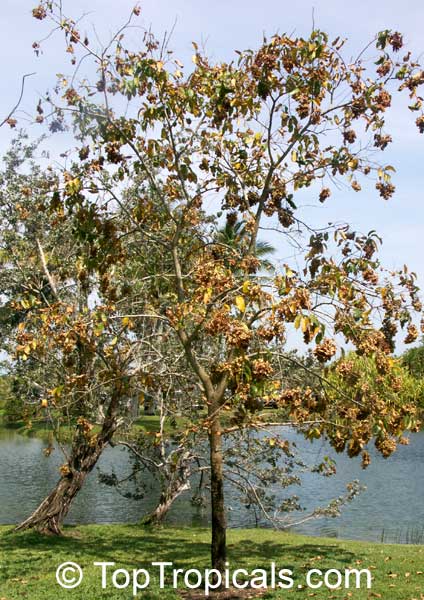
Conocarpus turned up numerous pictures of buttonwood. Here is
another good picture of the leaves and fruit, this time of a plant with more lanceolate leaves than in the other picture, and the fruit is still very young.
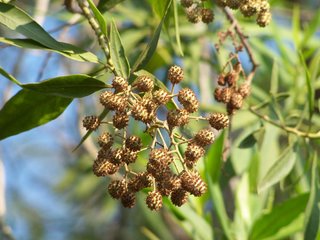
Although those are pictures of
Conocarpus erecta, they were similar enough that I concluded the mystery tree was most likely a
Conocarpus lancifolius. This made sense as the two species seemed quite similar: both are commonly used for firewood and especially charcoal, as the wood is very dense; both bear cone-like fruit in bunches (the mystery tree’s fruits are smaller and don’t seem to turn red, although I can’t verify that); both are popular for their salt tolerance. The
lancifolius has thinner, more lanceolate leaves (hence the name), smaller fruit, and seems to grow taller and is more commonly a single-trunked tree than erecta, at least by my observation. But they are clearly similar trees and it makes sense that they would share a genus.
Although there were no good pictures of
lancifolius on Google, there are three very good descriptions of the plant. This comes from a university in Kenya, part of a series on trees that would be
good for agroforestry in Kenya. It notes the local name of the tree, in Somali (it doesn’t appear to have an English common name), is Ghalab. The name in Arabic is Damas. Among other things the paper notes that the seeds are difficult to extract from their covers (as are the mystery trees seeds), germinate in standing water, and their viability is quite short (which means I don’t know whether I’m going to be able to get any home, though rest assured I plan to try).
The next resource is from the
IUCN Redlist of Threatened Species, which provides the tree’s entire taxonomy, notes it is native to Somalia and Yemen, and says the genus contains just two species. The
Redlist (it’s worth surfing around the Redlist’s site if you’re ever curious about threatened or endangered plant species native to your area that you could plant in your garden) is interesting in that it is the most up-to-the-minute information available. Changes in taxonomy take several years if not more, so if the mystery tree had indeed been removed from the genus Conocarpus, we can assume the IUCN would know.
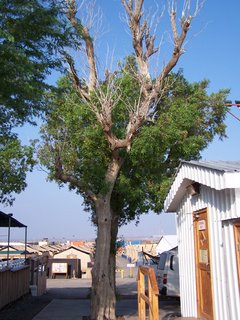
Far and away the most fascinating piece is this history of the
Haller Park Bamburi Nature Trail in Mombasa, Kenya. It doesn’t have any pictures of
Conocarpus lancifolius, but the tree was used by the Bamburi Concrete Company in their successful rehabilitation of the wasteland created by their excavation of limestone from a quarry not far from Mombasa. The essay is several pages long but well worth a read because it’s quite an interesting story, especially given that the Bamburi Concrete Co. undertook the rehabilitation in 1971 for no reason beyond that it seemed like a good idea at the time. There was no government grant, no Greenpeace protest. This was just plain good corporate citizenship in a country noted more for corruption than good corporate behavior. This study is actually referenced in the university website linked above.
Conocarpus lancifolius was used by the Bamburi Co. as a pioneer species in the limestone rock, and the tree was considered the most successful of the three species so used (the other two being coconut palm and
Casuarina (also called Australian pine), a plant you should never ever plant ever for any reason anywhere in the United States no matter how pretty you think it is).
So I was satisfied that I’d positively identified the mystery tree. And then I came across
Conocarpus latifolia.
I found it because two months went by between when I first located
lancifolius and when I started looking for it a second time, by which time I’d forgotten the correct name. I knew what it sounded like, and tried
latifolius instead. This led me to
latifolia. And this led me in turn to some surprising information. For example according to Wikipedia, the Buttonwood is
the only tree in the genus Conocarpus. This was attested by the
Free Dictionary among other dictionaries, all of which clearly used the same basis for their information since the wording was exactly the same. This source seems to be WordNet 2.0, from Princeton University. Princeton, though a fine institution, is not known for its botany program (it doesn’t have one; the closest it has is a strong program in evolutionary biology). Nonetheless, I decided that perhaps I had been mistaken all along, and that the mystery tree must not be a true
Conocarpus.
According to the Wikipedia article, the tree formerly known as
Conocarpus latifolia is now called
Anogeissus latifolia; it surprised me that this had not come up before when I was searching for information about this tree in August. I looked up
Anogeissus, which turns out to be a tree native to India that is clearly not the mystery tree.
These pictures should
be enough to
satisfy anyone as to that.
Once clear that
Anogeissus latifolia was clearly not the tree I was looking for, I started trying variations of
latifolia, and hit upon
lancifolius, where I rediscovered the articles I’d seen two months before. Now I was satisfied that indeed the
latifolia, native to India, and the
lancifolius, native to Somalia, were clearly not the same tree. But why all the references to
Conocarpus being a monotypic genus?
I went to every resource I could find that described
Conocarpus erecta, the Buttonwood, in any detail, looking for references to it being the only species in its genus. Floridata, Purdue horticulture, Virginia Tech, the University of Florida… on and on, no site that described the Buttonwood indicated that it was alone in its genus. No site that described
lancifolius indicated that it was alone in the genus, but neither did any site mention what other species might be in the genus.
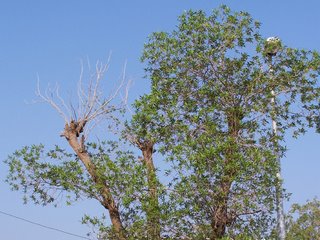
I went back to
Wordnet, whence the “monotypic”
definition seems to have sprung. It is not a dictionary of exhaustive research, but rather an attempt by the Cognitive Science Laboratory to “produce a combination of dictionary and thesaurus that is more intuitively usable, and to support automatic text analysis and artificial intelligence applications.” It was created and is maintained by a psychology professor. No doubt the mission of WordNet is a good one and the results positive, but how certain can we be that the definitions therein of an obscure botanical taxon are necessarily correct?
So I emailed Wordnet to see where their definition came from; no response as yet. I also commented to the individual who wrote the Wikipedia article to see where his/her definition came from. Then I sat back and waited to see if anybody actually knew anything or if this was just some sort of information loop.
The individual who wrote the Wikipedia article got his information from the
New York Botanical Garden, which indicated a monotypic genus. However, on my description he looked into it at other places, including the IUCN, the
Food and Agriculture Organization of the UN, and
CAB International. CABI, however, indicates that
Conocarpus lancifolius is also the same as
Anogeissus lancifolius, an assertion that frankly seems to be incorrect.
Anogeissus lancifolius is only described in a two locations: one, CABI, and the other being the recently edited Wikipedia article which links to CABI. I’m not one to say CABI is wrong but, CABI certainly doesn’t have anyone agreeing that it’s right. I strongly suspect that CABI has created their description on the basis of whatever authority moved the former
Conocarpus latifolia into the
Anogeissus genus; but
latifolia and
lancifolius are not and have never been the same tree.
The FAO page linked above describes both
Conocarpus lancifolius and
Anogeissus latifolia, leaving little doubt that the two trees are very different things. IUCN we’ve already discussed.
It’s worth pointing out that there are multiple taxonomic authorities, two of which have dealt with
Conocarpus. Listed as Engl. and Bedd., there is clear disagreement between the two; Bedd. seems to believe that
latifolia and
lancifolius are the same thing and creates the nonexistant
Anogeissus lancifolius. Meanwhile Engl. clearly describes
Conocarpus lancifolius as a separate species unrelated to
Anogeissus. At any rate, this seems to be the case based on CABI; that may simply be a typo and I've found no other descriptions of the tree citing Beddome, only those citing Engle. (Engl. is Adolf Engler, a German botanist and taxonomist in the late 19th Century. Bedd. is Col. Richard Beddome, a British military officer and amateur naturalist who described many of the plants of India.)
I went ahead and wrote to the
University of Florida Herbarium (FLAS) to ask if they could shed any light on the matter, being as they are a notable repository of information and particularly qualified to discuss
Conocarpus, as the Buttonwood is a Florida native tree. Haven't heard anything back yet. I have, however, gone on and put up a Wikipedia article for the mystery tree under the name
Conocarpus lancifolius, and we'll see what happens.
You may ask, why do you care, Smitty? And so I'll refer you back to the very top of this post: On deployment, a man'll do most anything to keep his mind occupied...